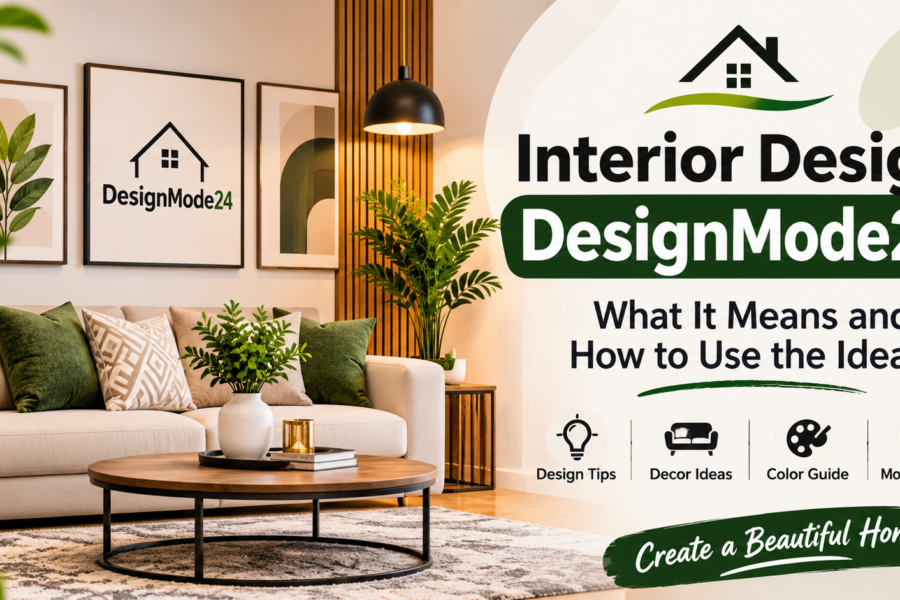
Search for “interior design designmode24” and the results look scrambled: decor tips, contact pages, guest-post pitches, and site-trust checks all show up together. That happens because the phrase is not a design style like Japandi or Mid-Century Modern. It is tied to a website name, and most of what ranks for it is thin content built around that name. This guide separates the name from the useful ideas, gives you real measurements and planning numbers you can check, and shows you how to judge any decor source before you spend money on its advice.
What Is Interior Design Designmode24?
The short answer: interior design designmode24 is a search phrase, not a design movement. One of the longer articles ranking for it states that the term is not a formally recognized design movement and is associated with home décor content on designmode24-related websites. That matches what the results show.
It is not a style you can buy into
Styles like Scandinavian or Art Deco have defining features, historical roots, and signature materials. Interior design designmode24 has none of these. You cannot walk into a showroom and ask for it. When a page claims to teach “the designmode24 look,” it is describing generic modern decor and attaching a brand name.
What the name usually points to
Based on the pages that surface for the term, it tends to mean one of three things:
- A decor blog or inspiration site that publishes room ideas, color palettes, and furniture tips.
- A guest-post platform that accepts paid or contributed articles on home topics.
- A keyword that other publishers use as a hook for general home-styling articles.
Knowing which one you are dealing with changes how much weight you give the advice.
Is DesignMode24 a Trustworthy Source?
Many searchers land here because they want to know whether the site is legitimate. The honest answer is that the signals conflict, so verify before you rely on it.
What the scanners say
One security scan rated designmode24.net “suspicious” at 55 out of 100, describing it as a professional-looking interior design site that operates as a guest-post platform, with no business registration, a shared admin email across multiple unrelated domains, and no customer verification. The same page also quotes other tools giving the site a more favorable trust score. Mixed ratings do not prove wrongdoing. They mean you should treat the site as unverified until you confirm things yourself.
A six-point checklist for vetting any decor site
Use this on DesignMode24 or any other source before following its advice or paying for services.
| Check | What to look for | Red flag |
|---|---|---|
| Ownership | A named company or person, an address, a registration number | Anonymous “admin” contact only |
| Portfolio | Dated projects with photos you can reverse-image search | Stock photos only |
| Authors | Bylines with design credentials or documented experience | Unnamed or rotating authors |
| Pricing | Written fees, scope, and refund terms | “Contact us for a quote” with no process |
| Reviews | Independent platforms such as Google, Yelp, or the Better Business Bureau | Testimonials only on the site itself |
| Advice quality | Specific measurements, materials, and costs | Vague phrases like “create harmony” |
If a site fails three or more rows, use it for inspiration at most. Do not send money or personal details.
Core Principles Behind the Decor Advice
Strip away the branding and the ideas filed under interior design designmode24 come down to a few durable principles. These are the ones worth keeping.
Function before finish
Decide how the room is used before choosing anything decorative. A living room used for movie nights needs different seating and lighting than one used for entertaining six guests. Write down the three things you do most in the room, then check every purchase against that list.
The 60-30-10 color rule with a real example
This rule splits a room’s color into proportions: about 60 percent dominant, 30 percent secondary, 10 percent accent. Here is how it plays out in a living room:
- 60 percent, walls and large rug: warm off-white or soft greige
- 30 percent, sofa, curtains, and wood furniture: walnut tones and olive upholstery
- 10 percent, cushions, art, and a throw: rust or terracotta
The accent should be the easiest thing to swap, so you can update the room later without repainting.
Three layers of lighting
Most rooms look flat because they rely on one ceiling fixture. Use three layers:
- Ambient: general light from ceiling fixtures or a floor lamp bounced off a wall.
- Task: reading lamps, under-cabinet strips, desk lamps.
- Accent: picture lights, a small lamp on a shelf, or LED strips behind a TV.
A room with three light sources at different heights almost always feels better than a room with one bright fixture, even if the furniture is identical.
2026 Trends Worth Your Money (and Some to Skip)
Trends move fast, and not every one deserves a budget. Houzz reported that searches for rust rose 178 percent, chocolate brown 153 percent, and sage 55 percent in early 2026 compared with the same period in 2025. Warm, earthy color is clearly where interest is heading. Here is how the main trends rank for practical value:
| Trend | Worth it? | Why |
|---|---|---|
| Warm earth tones (rust, brown, sage) | Yes, in paint and textiles | Cheap to apply and easy to reverse |
| Natural materials (wood, linen, stone) | Yes, selectively | Durable, but check moisture resistance in kitchens and baths |
| Curved furniture | Yes, if the room has space | Rounded pieces soften angular rooms but take up more floor area |
| Statement wallpaper | Maybe | High impact, but costly to remove, so avoid it as a renter |
| Smart home controls | Maybe | Smart bulbs are cheap and useful, while full automation rarely pays off in a small space |
| Heavily themed rooms | Skip | They date quickly and limit resale appeal |
The practical rule: put trend colors where change is cheap (paint, pillows, throws) and put long-lasting money into the pieces you touch daily (sofa, mattress, desk chair).
Room-by-Room Sizing Guide
Most decor mistakes are measurement mistakes. These figures are widely used planning guidelines. Measure your own room and furniture before you buy anything.
| Item | Guideline |
|---|---|
| Sofa to coffee table | 14 to 18 inches |
| Main walkway through a room | About 30 to 36 inches |
| Dining chair clearance behind the chair | 36 inches or more from table edge to wall |
| Rug under a dining table | Extends 24 to 30 inches past the table edge |
| Curtain rod height | Near the ceiling rather than just above the window frame |
| TV center height | Roughly at seated eye level |
Living room
Choose the focal point first, usually a window, fireplace, or TV wall, then orient seating toward it. In a room around 11 by 13 feet, a loveseat or compact sofa with two accent chairs often works better than a full sectional, which can block the path to the door. Leave the walkway clear before you add side tables.
Kitchen
The National Kitchen and Bath Association recommends at least 36 inches for general walkways, 42 inches for single-cook work aisles, and 48 inches for work aisles with multiple cooks. If you are adding an island, confirm those clearances on all sides first. An island that squeezes the aisles to 30 inches will annoy you every day.
Dining area
A table should seat your usual group, not your largest holiday group. Extendable tables solve this: they stay compact most of the year and open up when needed. Under the table, a low-pile rug is easier to clean and lets chairs slide.
Bedroom
Leave about 24 inches on each side of the bed for walking, and more if you share the room or use a bench. Put the strongest lighting beside the bed (wall sconces or lamps at reading height) and keep overhead light on a dimmer.
Budget Breakdown for US Homes
Costs vary widely by city, retailer, and quality tier. The ranges below are planning estimates, not quotes. Confirm current prices with the stores and professionals in your area before committing.
| Tier | Typical focus | Rough planning range per room |
|---|---|---|
| Light refresh | Paint, textiles, lamps, rearranging | Under $500 |
| Mid-range makeover | New sofa or rug, shelving, lighting plan | $500 to $2,500 |
| Full redesign | Custom storage, flooring, professional design fees | $2,500 and up |
Example: planning an 11 by 13 foot living room
This is a worked planning scenario, not a record of a finished project. It shows how to allocate a $1,500 budget by priority rather than by impulse.
| Category | Allocation | Notes |
|---|---|---|
| Seating (sofa or loveseat, secondhand or sale) | $600 | Biggest comfort and visual impact |
| Rug (8 by 10 feet) | $250 | Anchors the layout; front sofa legs should sit on it |
| Lighting (floor lamp, table lamp, bulbs) | $200 | Adds the second and third lighting layers |
| Storage (media console or shelves) | $250 | Reduces clutter |
| Paint and supplies | $100 | Pair with a test patch on two walls |
| Textiles and accents | $50 | Pillows, one throw |
| Reserve | $50 | For surprises |
Spend in this order: repairs and safety first, then seating and lighting, then storage, then decorative items last.
Where to spend and where to save
- Spend on: the sofa frame, mattress, task lighting, and anything you use daily.
- Save on: picture frames, vases, side tables, and trend-driven accents.
- Buy secondhand: solid wood dressers, dining tables, and bookshelves, which often outlast new flat-pack pieces.
Ideas for Renters and Small Spaces
Many people searching for interior design designmode24 ideas rent their homes or live in compact apartments, and most online advice ignores both.
Renter-safe upgrades
- Check your lease before drilling or painting, and get permission in writing when needed.
- Use peel-and-stick wallpaper on a test spot first to confirm it removes cleanly.
- Swap cabinet hardware and keep the originals in a labeled bag for move-out.
- Add plug-in wall sconces and use a bulb with a warm color temperature.
- Anchor tall furniture to the wall with the method your landlord allows, especially in homes with children.
Small-space tactics that work
- Go vertical: tall, narrow shelving uses wall space instead of floor space.
- Choose pieces with legs: visible floor under a sofa or cabinet makes a room feel larger.
- Use dual-purpose furniture: a storage ottoman, a fold-down desk, or nesting tables.
- Use mirrors to reflect windows, not blank walls.
- Limit the palette to two or three colors and repeat them.
Common Mistakes to Avoid
- Buying before measuring. Tape the footprint of a sofa on the floor and walk around it first.
- Matching everything. A fully matched set looks like a showroom. Mix wood tones and textures.
- Painting without testing. Paint a large sample and check it morning and evening.
- Hanging art too high. The center of a picture should sit near eye level, around 57 to 60 inches from the floor.
- Skipping rugs that are too small. A rug that floats in the middle of the room makes the space feel disconnected.
- Ignoring moisture. In bathrooms and basements, fix ventilation or leaks before choosing finishes.
- Following every trend. Pick one or two and keep the rest of the room neutral.
A Seven-Day Plan to Refresh One Room
| Day | Task |
|---|---|
| 1 | List problems: poor lighting, clutter, wrong layout |
| 2 | Measure the room and sketch two layouts |
| 3 | Declutter and move furniture to test the layout |
| 4 | Test paint and fabric samples in the actual room |
| 5 | Add or fix lighting and storage |
| 6 | Add rugs, curtains, and a few accessories |
| 7 | Walk through the room and adjust anything awkward |
How to Use Interior Design Designmode24 Content Wisely
Treat any article tagged with the term as a starting point for ideas, not as a verified authority. Here is a simple workflow:
- Collect ideas from several sources, including established ones like Houzz, Pinterest boards from named designers, and furniture retailers’ room galleries.
- Check every measurement against standards such as the NKBA guidelines.
- Price items yourself at two or three retailers.
- Use free planning tools such as Sweet Home 3D or Planner 5D to test your layout before buying.
- For structural, electrical, or plumbing changes, hire a licensed professional. Decor advice does not replace that.
Final Thoughts
Interior design designmode24 is best understood as a label, not a method. The label is murky, and independent scans of the main site show mixed trust signals. The ideas that sometimes appear under it are sound when they come with real numbers: clear walkways, layered lighting, a controlled color palette, and a budget built around priorities. Use the measurements, the checklist, and the planning tables above, verify prices locally, and let how you actually live in the room guide each decision.
Frequently Asked Questions
What does interior design designmode24 mean?
It is a search phrase linked to a decor website name, not a recognized design style. Most content using it covers general home-styling tips.
Is designmode24.net legitimate?
Ratings conflict: at least one scanner flagged it as suspicious, while others rate it higher. Verify ownership, portfolio, and pricing yourself before trusting it.
How much does it cost to redecorate one room in the US?
A light refresh can run under $500, while a mid-range makeover commonly lands between $500 and $2,500. Local prices vary, so get current quotes.
What is the 60-30-10 color rule?
It splits a room into about 60 percent dominant color, 30 percent secondary, and 10 percent accent. It keeps palettes balanced without feeling busy.
How far should a coffee table sit from the sofa?
Aim for roughly 14 to 18 inches. That keeps drinks within reach while leaving room to stand up.
What can renters change without losing their deposit?
Lighting, rugs, textiles, removable wallpaper, and swapped hardware are usually safe. Always check your lease first.
Which rooms should I redecorate first?
Start with the room you use most, usually the living room or bedroom. Fix lighting and layout before buying decor.
